How M.C. Escher’s Art Creates Bizarre Mathematical Worlds
A new New York exhibition shows how M.C. Escher's prints, made without formal mathematics training, became a lasting source of ideas for mathematicians.
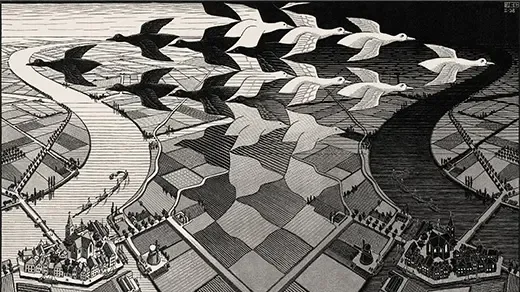
Escher, born in 1898 in Leeuwarden in the Netherlands, struggled with mathematics as a student and studied decorative arts and printmaking instead. He used his art to explore strange natural phenomena such as distorted reflections and superimposed worlds. His interest in repeating patterns began after a 1922 visit to the tiles of the Alhambra in Granada, Spain. Later, his half-brother, the geologist Berend, sent him a paper by mathematician George Pólya that classified all the ways to cover a flat surface with tiles into 17 symmetry groups.
Escher developed his own system for tessellation, filling prints with irregular shapes resembling fish, birds and lizards. In 1954 his work was shown at the International Congress of Mathematicians in Amsterdam, where he met H.S.M. Coxeter. The two corresponded until Escher's death in 1972, and their exchanges inspired some of his most complex work, including the Circle Limit series. Exhibition curator Doris Schattschneider said he had worked out his own theory for matching tile edges.
The exhibition Mathematics and the Art of M.C. Escher runs at the National Museum of Mathematics (MoMath) in New York through February 8, 2027. Later mathematicians also drew on his work, for example Hendrik Lenstra and Bart de Smit, who reverse-engineered the mathematics behind Print Gallery in 2003.
Why it matters
The article shows how an artist's intuition about geometry, without formal training, still shapes mathematical research.